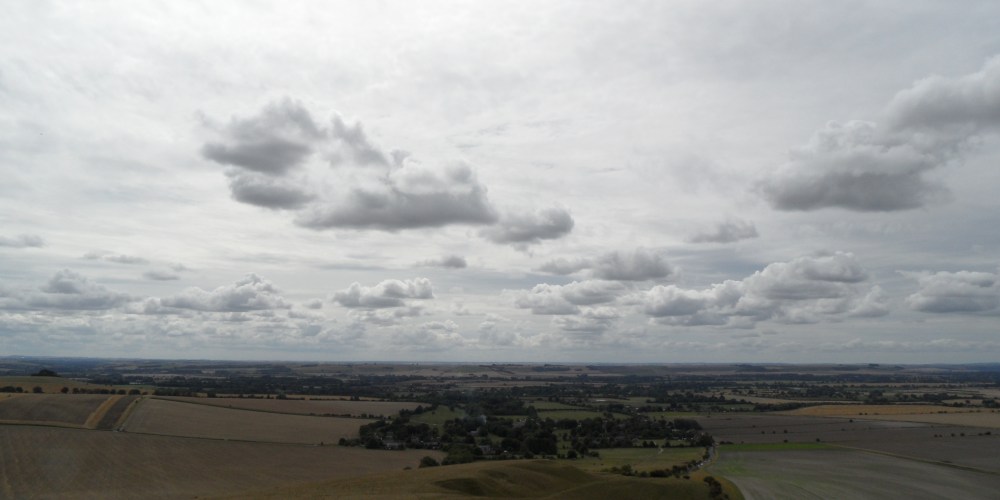
With the sun casting only sporadic warmth through the greying clouds, this particular Sunday morning is typical of this particular August week. The drop in temperature and the dark skies have produced an autumnal feeling that is a long way from the high summer suggested by the calendar, but none of that deters a steady flow of people from marching across the historic Marlborough Downs.
We steal the final remaining space in the car park, just off the main road that traverses the hills from the village of Alton Barnes towards Marlborough, and leave on foot through the sheep fields on the other side of the road towards Walkers Hill. We are by no means alone and those seeking solitude are best advised not to come here on a weekend, but if you don’t mind exchanging regular hellos with fellow hikers then the company adds a certain charm.
While all the land on the hills is used by farmers for their livestock, there are fairly well established routes that are easy to follow and do not place any demands for huge levels of fitness. The little effort that is required, though, is well worth it. The true magic of the Downs, in my opinion, always lies in the contrast between the ‘inner’ part of the hills, where rising grass in all directions makes you feel enclosed, like you are in the middle of an enormous bowl, and the ‘outer’ slopes.
After just a few minutes’ walk, this contrast is strikes in all its glory. After passing through a couple of gates, the crest of the hill is now before us and each step of the approach reveals more of the breathtaking surroundings below. Suddenly that large bowl has gone and the Vale of Pewsey opens up beneath us, spreading out for miles into the distance. A number of villages dot the landscape, interspersing the endless fields of varying shades and colours before the hills of Salisbury Plain roll forth at the far side a few miles away. A late summer haze, caused by dust from the harvest, does nothing to dampen the impact of this sudden world presenting itself.

Looking along one of the Adam’s Grave ditches on Walker’s Hill, revealing the Vale of Pewsey below.
Drinking in the view, we decide to follow the path along the southern ridge, this time populated by cows rather than the sheep which had occupied the other side. The contours rise once more, the path now taking us through gorse bushes, before curling round northwards. This curve reveals the face of Milk Hill and the white chalk horse it proudly boasts to all down in the Vale below.

The Alton Barnes White Horse on the face of Milk Hill.
White horses on hillsides are one of Wiltshire’s claims to fame, with 13 of the 24 known to have been built in the country appearing here. Exactly why people have historically been drawn to doing this is not really clear and this particular one seems to be no more than a product of the nineteenth century landowner’s whim. Commissioned by Robert Pile in 1812, it now brings many visitors to the area and, at 160 feet by 166 feet, is a reference point visible throughout the Vale.
A family passes us by, desperately trying to coerce their dog into following obediently, with young children demonstrating the comfort levels of this walk. We make our way round towards the horse, which itself is fenced off but the path almost guides us along its back. Up close the details become clearer, from the pointed ears to the patch of grass which forms its eye, making it clear this is much more a work of art than a hastily cobbled together bit of fun.
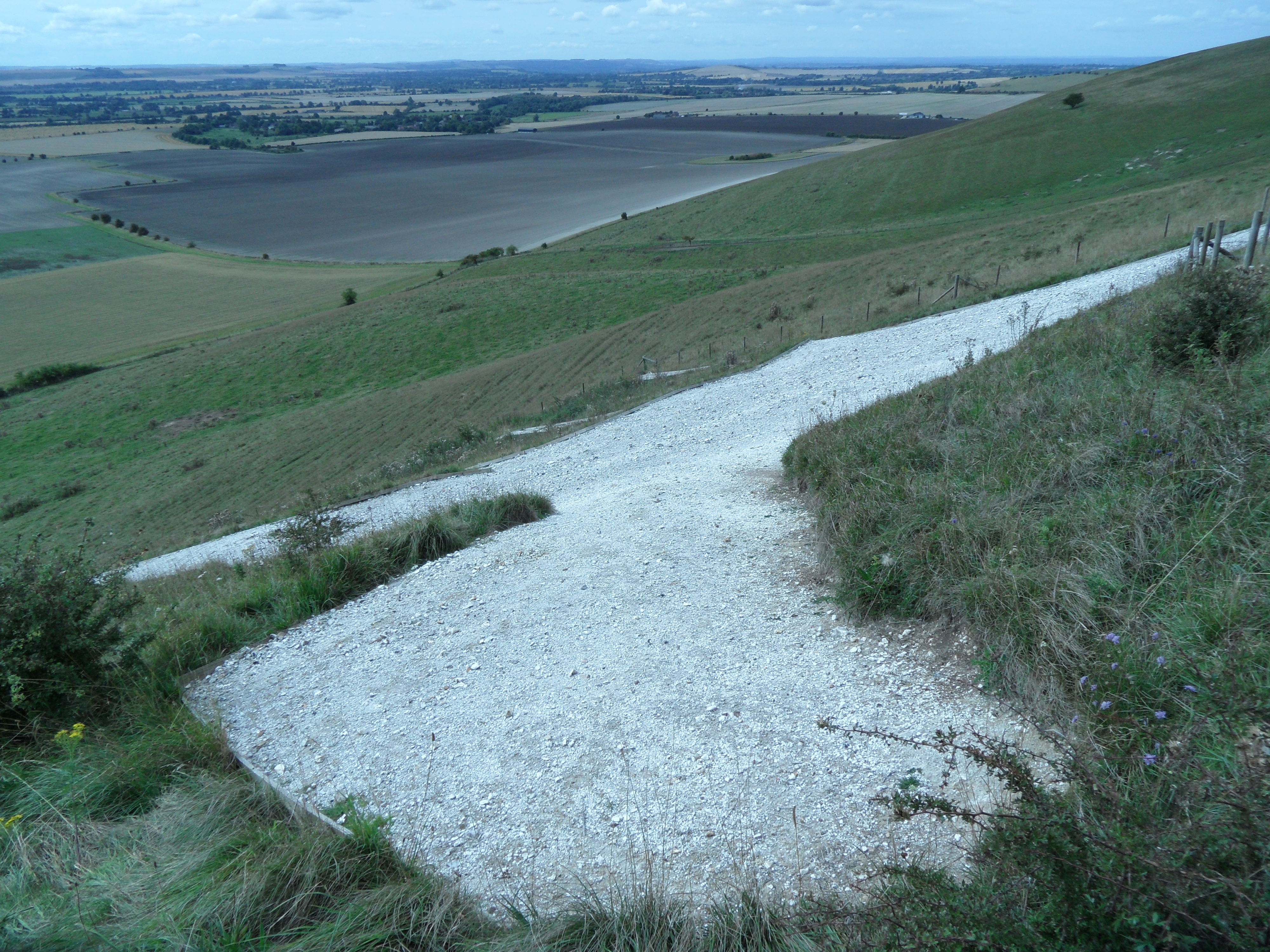
The tail of the White Horse, looking south-west towards the villages of Stanton St Bernard and All Cannings.
Beyond the horse, most walkers tend to carry on along the Downs towards Devizes, but I fancy something different and guide us ‘off-piste’, trekking our way back up towards the summit. As well as boasting the white horse, Milk Hill is also the second highest point between Bristol and London and the views it offers are well worth the climb. From the right spots it is possible to have the Vale on one side while being able to see Silbury Hill and Avebury on the other.
The north side of the hill drops us back down into the great grass bowl of the inner slopes and we skirt around the edge of a few sheep fields, something I won’t entirely recommend but not really a problem if you don’t do too much to disturb the livestock. It is also a more taxing walk and you will end up having to hop over some barbed wire fences as there are no gates to ease your thoroughfare. Circling back round towards our starting point, we want to return to Walkers Hill where what appears to be a small mound sits like a nipple on the peak.
The very deliberate-looking ditches around the mound- which I used to sledge down with friends in the snow when I was young- hint that there is more going on than first appears obvious and, although there is no information on any nearby signs to explain, the ‘nipple’ is actually another of Wiltshire’s many neolithic burial mounds, known as Adam’s Grave. Its history is vague, although some reports suggest that a nineteenth century excavation discovered three partial skeletons inside and, to excite the children, a couple of bloody Anglo-Saxon battles were fought here in the 6th and 8th centuries when it was known as Woden’s Burg. Any sort of discernible structure is now long gone but enough remains to pique the interest of those who study these kinds of things. For those who don’t it is still highly recommended as the finest viewing spot of all.
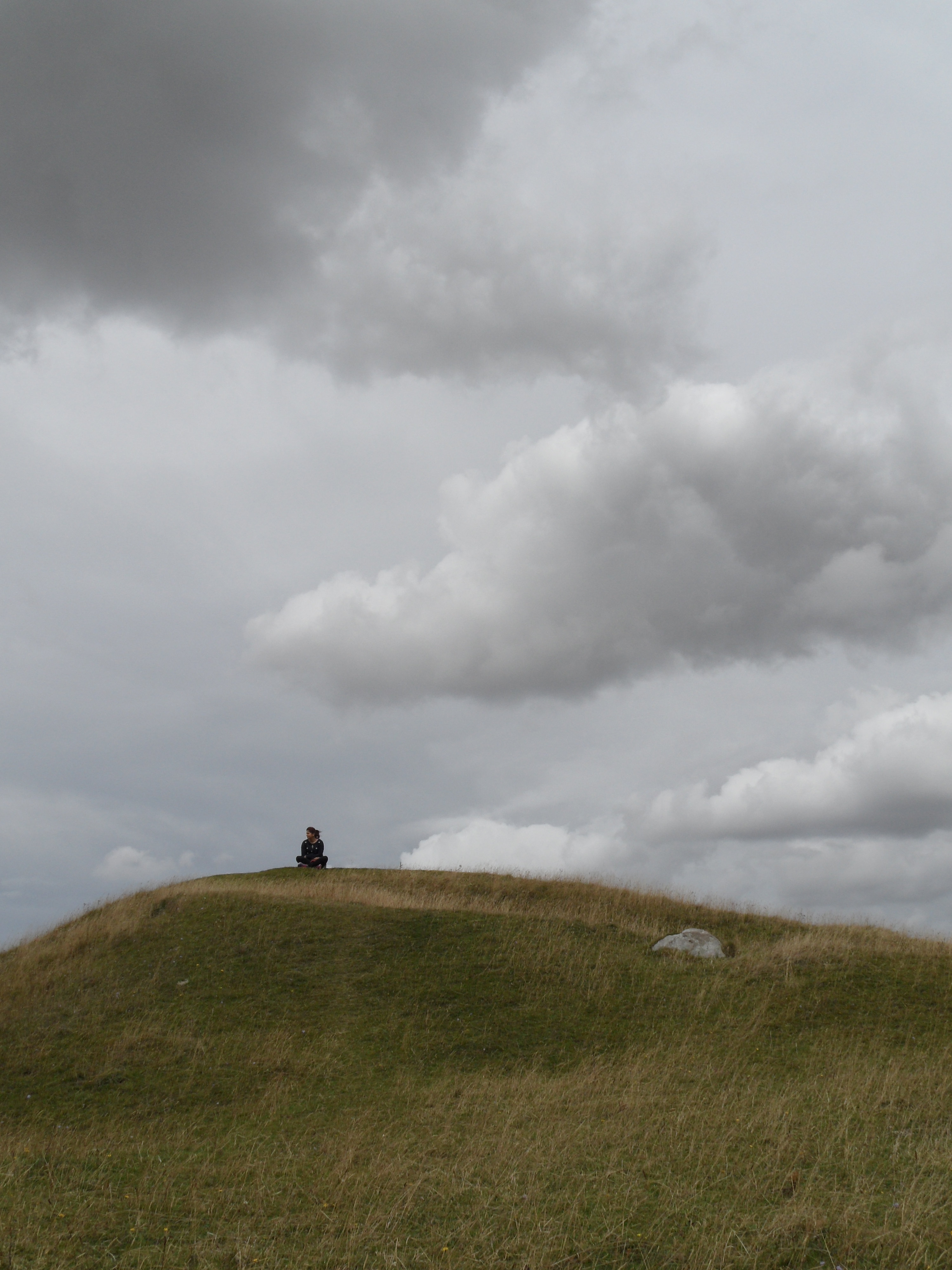
Sitting on top of ‘Adam’s Grave’. Visible is a large stone that likely formed part of the original structure.
We spend a good ten minutes sitting on the very peak here, marvelling at the 360 degree vista. Upon taking the time to really pause, the silence becomes striking and it is by a distance the most serene point of the walk. The only disturbance comes from a gentle breeze; all other walkers might as well be a hundred miles away instead of a few hundred metres and the roads and villages visible below seem to be in another world, all activity playing out silently on a stage that we have no place on.
It is at this point that the famous British summer time begins to catch up with us. With the sky now getting ever more grey we rouse ourselves from our reverie and make a retreat to the car. Regardless of the imperfect weather, though, it had been a beautiful way to spend a weekend morning and, of particular importance on this autumnal feeling day, the ideal prelude to a Sunday roast.
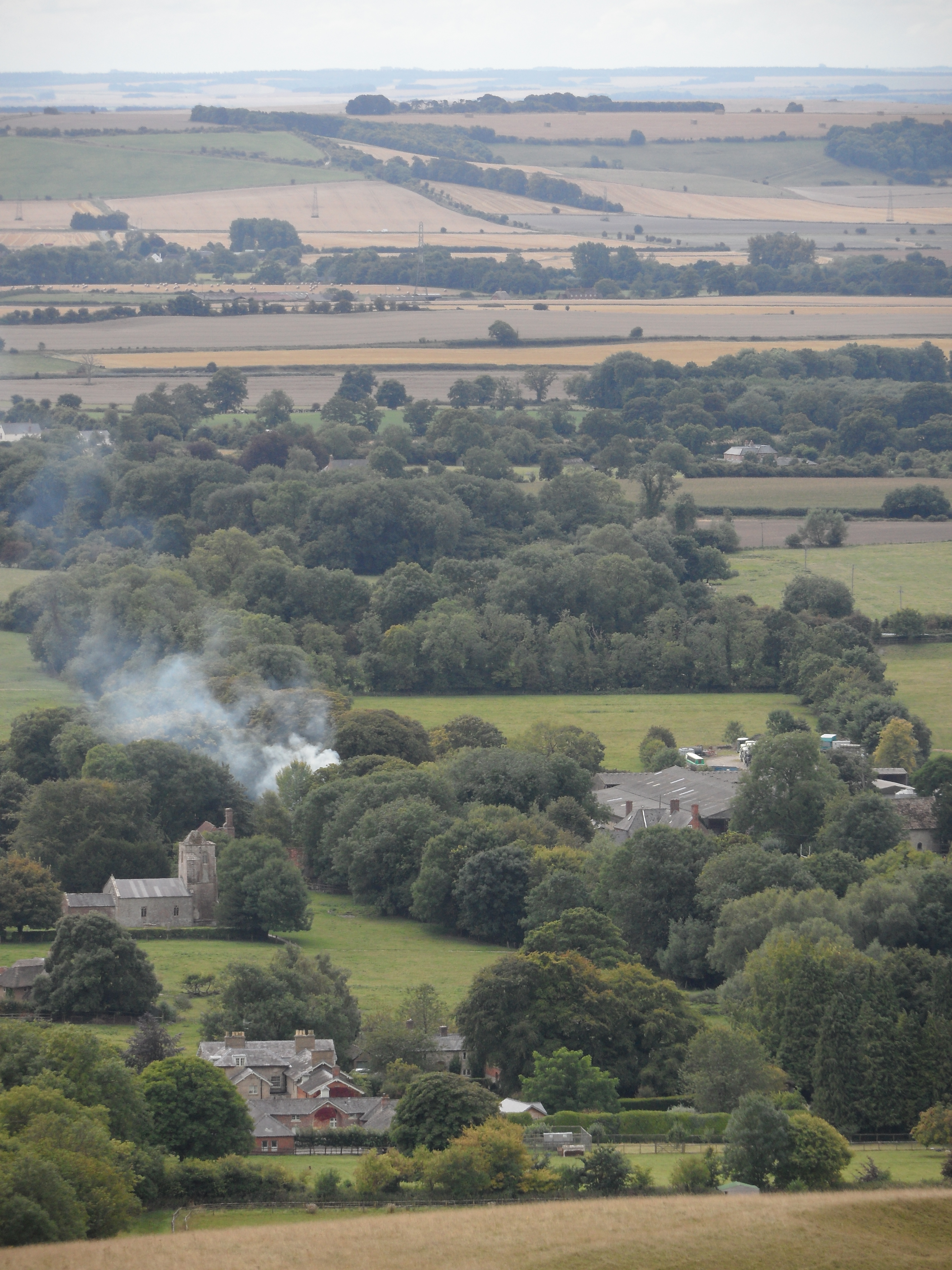
Alton Priors and beyond, seen from the top of Walkers Hill.
 That Cluckin' Bustard